
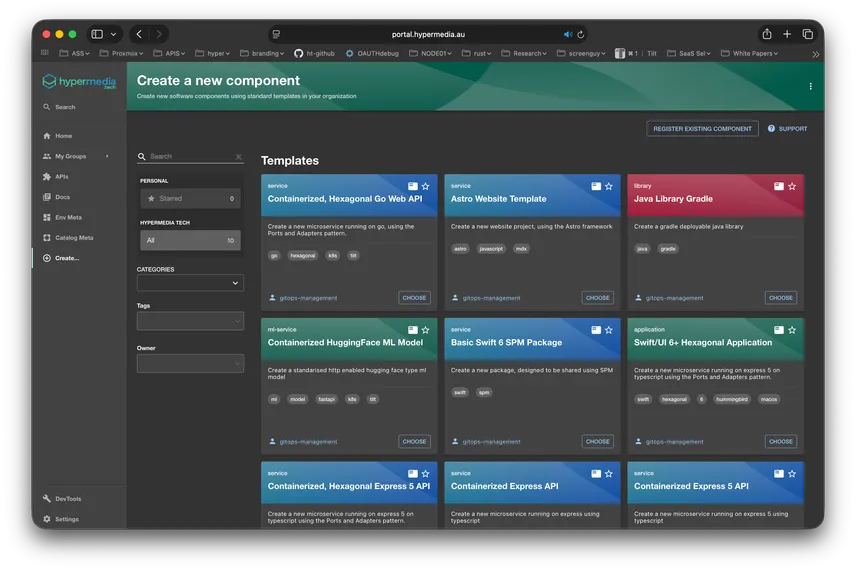
At its core GitOps means managing infrastructure and application deployments as code, treating Git as the single source of truth for your environments. That greatly simplifies operations, reduces cognitive load, and lets teams ship faster with confidence.
It also means every change is logged, versioned and auditable, so there is no drift and no guesswork about how an environment came to be the way it is.
80% of engineers say better continuous delivery tooling is the most impactful investment for productivity.
Gartner
Pragmatic GitOps
Pragmatic GitOps means adopting GitOps in a way that is aligned with human interaction, rather than chasing an idealised model that breaks down in practice. It is about practical automation, not dogma.
It is a journey and not a big bang. GitOps is not all or nothing, and a phased introduction reduces the pressure on your teams as new capabilities emerge. The early win is usually a developer portal, because discovery and visibility of your technology assets, and of who owns them, pays for itself before any deeper automation lands.
Humans stay in control. A UI allows managed, safe interaction with your application and infrastructure catalogs, instead of your engineers manually updating scores of YAML files. Where user action is genuinely required we automate progressively around it rather than removing the person.
Introducing automation progressively means fewer disruptions and faster wins. We start with your high friction areas, and we undo the flakey shadow CD practices that build up when continuous integration tools quietly take on deployment responsibilities nobody assigned them.
A survey at KubeCon Paris ‘24 found that 67% of GitOps experts advocate for Pragmatic GitOps.
What this means for you
Higher delivery performance, because pragmatic GitOps improves your DevOps KPIs directly rather than as a side effect. A better security and compliance posture from day zero, because standardised templates carry it in. And faster approvals with fewer delays, because teams that can revert instantly to a known good state ship with more confidence.
Deployment becomes about shipping rather than wrangling infrastructure, and self-service lets your teams experiment rapidly in a near production-ready state.
A phased implementation
We work in three phases so that value arrives early and nobody is asked to swallow the whole thing at once.
Phase one, foundations. Catalogued technology assets, integration with your version control system and other identity providers, and basic technology and people discovery. Catalogued workloads emit a deployable artefact, and artefacts expect external configuration at deployment. Catalogs map workloads and configuration to a deployment environment, with pilot workloads configured manually while the implementation progresses.
Phase two, automation. A container publish event triggers deployment of workload artefacts to lower environments through ArgoCD or FluxCD. New software projects initialise automatically from standardised project templates with customisable build patterns.
Phase three, the portal as a pane of glass. Catalogs managed through custom portal panels, including workload configuration, advancement between environments, and environment testing. Then event driven continuous delivery, reacting to events in your environments and CI processes, passing messages to your chat infrastructure, load testing workloads, and tagging and signing containers that have passed validation.
These three phases are how we run an engagement rather than just how we roll out tooling, and they are described in full on the Your Stack page.
Automation on Apple platforms
Very little of this has reached the Apple ecosystem yet. Signing, notarization, provisioning profiles, reproducible builds, runner fleets and TestFlight promotion are still largely hand-cranked, and most teams shipping on Apple platforms have quietly built their own fragile version of the same thing.
It does not have to be that way. We can help you apply the same discipline here that we have been applying to enterprise cloud for years, so that shipping a Mac or iOS application becomes a pipeline your team trusts rather than an afternoon somebody loses.
Pragmatic GitOps
Practical automation aligned to how your people work, introduced in phases rather than all at once.
Proven at enterprise scale across Energy, Banking and Cyber Security, and running today in our own products.